Summary
I was born at an early age in Queen Elizabeth Hospital, Nairobi, Kenya, in 1955. At birth, I was variously described as looking just like a dried prune or my brother, a comparison that did not go down well with the elder sibling.
My looks improved, to the point where his mother felt free to enter me in for the Heinz Bonny Baby contest, an accolade I thankfully did not win. Instead, I devoted his childhood to jumping into ditches (head first) and falling out of trees. My parents attempted to toughen me up by introducing me to the British weather, and in particular the British seaside. My first experience of this (in contrast to the warm, smooth coral sands of the East African Coast) was that of Brighton beach – an event that scarred me for life.
School
I started at King William’s College in 1966, at the age of 11. My parents decided to send me to this school because of the connection it had with one of my great uncles on the Housden side, who had also attended the school. My father had gone to Liverpool College, which he didn’t like, and so I ended up with its equivalent on the Isle of Man.
My first question on seeing the grey towers of the school, set in rainswept fields by the pebbled beach of Derbyhaven was “Dad, is this the local prison?”. Nine years later, I could confirm that it was. I failed at school. The priorities of the college appeared to be
- Achieve the first XIV in Rugby
- Go to Oxford or Cambridge
I failed miserably in both of these. Anyone who gets the impression that I don’t have fond memories of the place must be psychic – or else went there themselves.
Early years
I started off in Junior House. Housemaster was Mr Cyril Attwood. Some of the things I remember about this house are:
- Pockets sewn up: The pockets of Junior boys had to be sewn up to stop them putting their hands in their pockets and ‘slouching’
- Sunday lie ins. We were up early during the week, but on Sunday we could have a ‘lie in’ (enforced). Memories are of being in the dorm with the sunlight streaming through the windows.
I did quite well at sport in these early days. I was big for my age, which made me able to battle my way through a rugby scrum. I was good at cross country, because I had lived at 5,000 feet up till then, and my stamina was good as a result. I was also good at swimming, due to the swimming training that I’d had in Kenya.
As for friends, I don’t recall myself as being either unpopular or popular – merely middle of the road.
Colbourne House
On leaving Junior House I was accepted into Colbourne House. In retrospect, this was not a good move. The house was the sporting house of the school, and it turned out that I was more the acedemic type, not sporting. The other houses would have suited me better – my recollection of them is:
- Dixon – the academic house
- Walters – no outstanding characteristics
- School – definitely for the upper crust, hidden away in the back parts of the school
- Hunt house – for day boys
The regimen was approximately
- ?7:30 Breakfast in the main hall (the Barrovian Hall)
- 9:00 – 12:00 School work
- Lunch
- 2:00 – 4:00 School work
- 4:30 – 6:30 Sports. This was Rugby in the Winter term, Hockey in the Easter term and Cricket (or tennis) in the summer term.
- 7:15 Supper
- Prep (class work)
- Bed
I started off in the Junior Common Room. This contained about 20 boys. Prep time was held in this room, supervised by one of the senior boys; Our books were held in lockers that lined the walls (there were larger lockers in the corridor outside). We slept in the Junior dorm, on beds and matresses that had seen better days. The windows in the school were of the sash window type, and as such were not all that wind proof. We would jam bits of paper in the casement just to stop the windows rattling in the wind. KWC is in an exposed position on the South coast of the Isle of Man, and winds were a norm rather than an exception.
On Saturdays we only had school in the morning. The afternoon was games (generally a match of some kind). At 5:15 we had free time, wich was normally spent in the lecture theatre watching television. The timing coincided with Doctor Who and the Golden shot, so we were very familiar with that.
Meals were taken in the Barrovian hall. Each house had its own set of long table and benches. The most senior sat at the top going down to the most junior. The tables were presided over by one of the senior boys. I think there was a Junior, middle and senior table for each house. Breakfast and Lunch were preceded by grace, which is given below:
Benedic domine nobis, et his donis tuis, quae de tua gratia et munificentia, sumis iam sumptiuis. Et concede ut, illis salubritar a te nutriti. Tibi debitum obsequium, praestare valeamus; per iesum christum dominum nostrum. Amen
Google translate has this as “Bless us, Lord, and these gifts of yours. We are already the recipients of your grace and bounty. And grant that those nourished by you may be healed. We are able to render the service due to you. Through Jesus Christ our Lord. Amen”
Small wonder that Mr Turnbull, ever the cynic, summarised it as “You give us something so that we can give you something”
And after dinner
Pro bono cibo et solidate bona Te Deum Laudamus neccesitates qoque aliorum obseqcramus sustine, ut tibi semper gratias agamus. Per Iesum Christum Dominum Nostrum
Which translates as .. “We praise God for good food and solidarity. Let us support the needs of others. As always we thank you. Through Jesus Christ our Lord”.
There was one occasion in senior school were we went out for an (illegal) drink. My ‘friends’ spiked my pint with vodka. I was a prefect (or ‘Praepositor’, as they chose to call us) and it was my turn to say the grace. I am told that my housemates were quite impressed by the way i managed to pull it off. I thenb had to sit at the high table with the housemasters and pretend to be sober. I still don’t know if I pulled it off, but no master made any comment. That afternon was supposed to be a rehearsal for a play but I believe I spent most of it sleeping the effects of the drink.
In my final year the Housemaster (Mr Turnbull) decided to make me, one of the most introverted boys in the house, Head of House. I have no idea why he did this but I suspect it was to give me character. There were other, better candidates .. any of the boys on the various first teams would have done given the house’s sporting record, but it turned out to be me. I did not enjoy that year. Wasn’t particularly popular with my peers at that point and this didn’t help.
Masters at the school
Latin – Mr Turnbull; Housemaster of Colbourne – Mr Hardy, followed by Mr Ian Turnbull; English; Mr Noy; Chemistry – Mr Christian (‘egg’ because of the bald head); Physics was Mr Parkinson, far too cynical to be the school chaplain; Headmaster Mr Rees-Jones; Mr Boyne, housemaster of School house, noted for his fondness for the odd tipple (i only discovered this a lot later on but it did explain the enormous red nose). There was the master of woodwork (Mr Wilson) whoe most famous quote on finding a boy making a mess of his work was heard to utter ‘Wood doesn’t grow on trees’. Maths master Mr Bob Garland(known as Toad because of his build). Very good maths master and probably responsible for my existng career in computer systems; he held an evening class in computing. At the time this consisted of punching out Fortran programs on punched card and then sending them off to Imperial College to be run on there computers there. The resultant printout was then returned to us.).
Inter University
I took a break between School and University, working with the Community Service Volunteers for a year at a mental hospital called Calderstones, near Whalley, Lancashire. The purpose of this placement was to provide a group of people to assist in a ward for mentally impaired guys (physical age anything between 18 and 30, mental age somewhere around 3-6). An interesting job, some opposition from one of the ward staff and you can’t imagine how messy it is when a 25 year old poos in his pants. I still have the clogs I bought at that time.
Some memories
- Building box kites out of bamboo and tissue paper
- One of the lads being allowed to smoke but not allowed matches so had to ask for his cigarette to be lit “Massy Bee”. He was able to look after himself.
- Going to Butlins. Mostly OK although one of the guys, built like a brick, started getting stroppy and had to be encouraged into his room.
- The Calderstones play “pink champagne”.
- One of the volunteers had a relationship with one of the charge nurses, got her pregnant and left. I was in the same nurses hostel as her and was encouraged by one of the older staff to ‘comfort her’. Thankfully I didn’t.
University
I spent my time at Leeds honing my skills at cider drinking, table football and a bit of Electronic engineering on the side.
The first year was spent at the student residence of Bodington Hall. The first four days was spent in almost total verbal isolation, not talking to anyone but going to classes and getting meals at the hall, studying and sleeping. Then I discovered table football in the games room. I discovered I had quite a talent for this, mainly as the backs and goalies and quicly discovered how to score a goal from the back.
The second year was in a unit at the University’s Lupton Flats (self catering), along with John Gunton, Peter Jones and ??. In typical engineering fashion I bought a cookbook and then worked my way through it. I experimented with cutting my fingers off with a blunt knife and failed, although the resultant blood would have made a nice stock.
The final year was spent in digs just opposite the Parkinson. It was an old Leeds back to back and came complete with mould and cold. Eventually I moved into Garstang Flats on the campus.
My final year project was the determination of the effective resistance of an induction motor through testing and simulation. The simulation part was spent on the DEC10 computer up in the Physics block. This was a near disaster. The project went well but I was under the impression that only one of us had to type up the project report. I only discovered that this wasn’t the case about a day before the report was due. Some frantic work ensued and, with the help of Mum, who typed up what I*’d written, I submitted the report. However, it was pretty short and my tutor admitted that if I’d submitted a proper report then I would have attained a ii 1 rather than a ii 2 grade.
Much to my horror I gained a degree and a place with an Electrical engineering firm in Rugby. I’d applied for two places. The first was with British Rail. The interview included a group tour of Euston Station and Crewe. The second choice was GEC Electrical Projects in Rugby.
Work
Early years
I started work with GEC Electrical Projects on 14th September in 1977. At the time GEC Industrial Controls and GEC Electrical Projects shared the same training course, headed by Mr Quartermain. My industrial supervisor was Mr Platt; I went into SDD, Metals applications (under Mike Leppard – planning out Modicon programs I believe), Gen Industries sales (attempting to buy lighting equipment) and Industrial Controls (spent most of my time sleeping) also spent some time in the test area.
This training was over a period of a year, so in 1978 I started work in the Systems Design Department (SDD). In theory I was to be attached to Roy Caddy’s section (which did general drives stuff) but was put into Eric Lewis’ section instead (DC minewinders). I effectively stayed in this section until 1991.
My first job was cleaning and rebuilding a Magamp (magnetic amplifier, which uses the saturation effect to amplify an AC signal). This predated the technology of the time, which had just started on the 700 series of electronic modules, with the power side provided by the T123 firing pulse module and the Mk 7 power stack. These latter two were really designed for low power applications but were ideal for the majority of the applications we were involved in. This was because British Coal was in the process of renovating all its winders as a result of the adverse report into the Markham disaster (where a brake rod broke on a winder and as a result of this single line breakage a cage full of men fell to the bottom of the shaft). British Coal were replacing all their equipment by dual line systems and electronic control, and GEC were making a mint out of it. The nature of the equipment was that it was only the electronics that were being replaced. The motor/generator sets used to provide the power were being retained, so effectively all we were controlling was the field of the generator. Some jobs were even Amplidyne Ward Leonard (usually kept because the generator field windings were so old that the insulation couldn’t stand the dv/dt of a thyristor based control signal).
I spent several years putting together Ward Leonard systems. Eric had the engineering of this down to a fine art – we were shunting out so many that he had produced a standard set of wiring instructions and cubicle parts lists that could be used by the manufacturer to produce that actual job with the minimum of fuss. Variations were handled by a tick list which picked up various parts and various wiring diagrams. Working values for the job in hand was sert up on standard work sheets. All this predated the use of spreadsheets and computer databases.
Mines that I was personally involved with were: Bevercotes,Clipstone, Hatfield, Easington, Markham (as in disaster), Manton, Seaham, Westoe and Wearmouth with involvement in Rossington, Maltby, Ollerton, Howarth, Bilsthorpe, Brodsworth, Markham Main (I did a 3 months FED experience commissioning this winder), Grimethorpe, Shirebrooke, Silverhill, Holditch.
I then moved on to the implementation of the ‘M-Reg’ control boards. This were mainly used in the South African mines, and I spent a few months in South Africa helping with the testing and installation of these boards (the first one that I know of was installed in the sub vertical winder at Leeudoorn – not by me). I did go down to Leeudoorn sub vertical .. it was terryfing working down there in temperatures of 40 deg C. We had a massive convertor vent fan blowing air at us to keep us cool and we still sweated buckets. In fact, the first M reg boards installed on the winder didn’t have a conformal coating and I recall the story that Robert Gatley, the engineer, sweated all over the boards to such an extent that several years later they had to be replaced die to corrosion of the tracks.
Bits and Pieces
We were gradually moving onto digital stuff in the drives field. A few projects stand out
Coincidence control. Mine winders pull a cage up and down shafts. With a drum winder you would have two cages (one at the bottom and one at the top) with a drum and rope for each cage. The drums would normally be mechanically coupled, with a clutch to allow independent movement of the a single drum to adjust the level of the cage (especially useful for a multilevel winder). However, some of the South African winders were electrically coupled (i.e, the drums were driven by independent motors which were controlled to keep the drums in synch. As with anything there had to be a safety system behind this and we created a box called the coincidence control. This was driven by independent position measurement devices on each drum fed to a bit of digital electronics (NOT a microprocessor) that compared the two and put out a signal indicating any discrepancy. This could then be used to indicate how much difference there was between the two drums. The electronics was a single board of integrated circuits .. I don’t think we produced many of them! It did give me an opportunity to go out to South Africa in the mid 1980s to test the boards that were being manufactured in that country.
Power Monitor. One winter morning a winder in the North Notts area was starting up. The winder had disc brakes and the first wind of the day had men in the cage. Towards the end of the wind the driver thought he had heard something and pressed the emergency stop. This applied the brakes and then removed electrical control when the brake limit switches indicated that they had been applied . Unfortunately, the nice shiny disc brakes had hit the dew point and were coated in condensation; the brake pads aquaplaned over the water and the winder continued down the shaft, slowing down but not fast enough. Fortunately there were wooden sleepers across the bottom of the shaft otherwise the cage full of men would have wound down into the water filled sump and likely drowned.
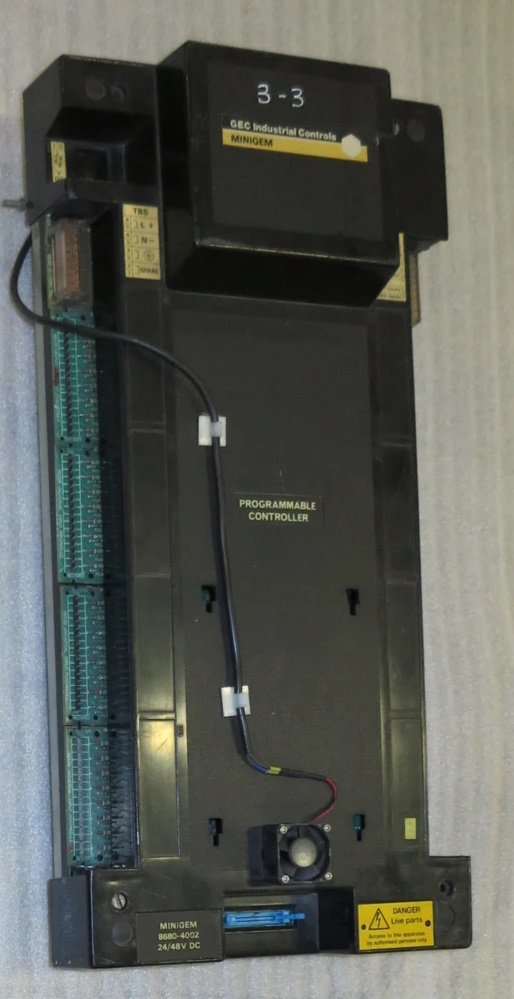
Given that men had been involved there was a Health and Safety Investigation. The resultant report recommended that in the event of a non electrical emergency that the electrics were retained to help with braking. However, this presented another problem .. what would happen if the electrics started powering through the brakes? To get round this we created a safety monitor that would shadow the slowdown of the winder and if the system was not slowing down correctly would shut off the electrics. We called it the power monitor and it was based on a Minigem .. one of the GEM80 family. The minigem was flat enough that we could mount it in the door of one of the cubicles. We upgraded a lot of the North Notts area winders with this system.
Stability Monitor. Mine winders were a critical bottleneck in the mine’s production and ti that ened, had to be reliable with any downtime kept to a minimum. To this end we provided a complete replacement of the regulator control electronics (a box about 60cms x 30 cms x 30 cms). The replacement unit was configured to have the same parametrisation settings as the in service unit, and we provided a test cubicle to allow the customer to set the system up electronically to be the same as its twin.
One fine day one of the GEC engineers went to the mine to perform some tests on the spare unit. When he left, he inadvertantly left one of the settings at the wrong value. This particular setting affected the speed control stabilising.
A few weeks later there was an ussue with the controller in service and it was swapped out for the spare.
To explain what subsequently happened it is important to know the characteristics of a mine winder, which can be equated to a large weight (the cage) at the end of a large spring (the rope). Any sharp movement results in an oscillation in the spring and at a particular length this oscillation can hit the resonant frequency of the spring and result in very severe oscillations.
This is exactly what happened. As the winder moved through the shaft it hit the resonant frequency of the rope and the resultant oscillations were so severe that the steel rope was kinked (and obviously had to be replaced). I believe the winder was hauling coal at the time otherwise the consequences could have been severe.
The engineer at fault wasn’t sacked. Instead, his boss who was in charge of winder development managed to persuade British Coal that what was required was a safety device that would detect oscillations and shut down the power before it could become an issue. BC bit, and the Stability Monitor was born. This bit of electronics had to detect oscillations in the rope without shutting down on the normal oscillations caused by a change in speed, for example. A lot of simulation went into this and eventually we delivered and tested the thing. The winder was run up the shaft with stabilising turned low and .. the winder started oscillating, the winder house shook, the BC engineers started to go white and .. the thing worked. GEC had managed to sell something to BC to detect a fault created by a GEC engineer (me). That is what I call sales.
Transputer.
Commissioning MWS2000
IN 1987 I spent about 3 months (August/September/October) helping commission Leeudoorn No. 1 Winder in South Africa (64 km, 1 hours drive SW of Johannesburg). We had spent some considerable time in Systems Test sorting out the dual line operation but the fine tuning took place on site. Joe Martins was the boss and Brian Wooton and I flew over from the UK to develop/commission our stuff.
This was the first of the MWS2000 systems – an all digital winder system which was the brainchild of Eric Lewis – and we were responsible for the lot .. HV and LV switchgear (the latter being the control for the pumps, valves, fans etc), Control, Safety, Drive regulator, Desk display and Driver’s control and Supervisory Alarms and History Logging. The project was several years in the making and we were all out there to make sure it all worked.
My responsibility was for the PLC logic for the GEM80 based Control, Safety, LV & HV control; The LV and HV control was based on GEM100s, the Control & Safety PLCs were the top of the range GEM350s. I think Harvie Lambie, one of the expert engineers from the Jo’burg office, was responsible for the software for the Hewlett Packard PC based Supervisory computer; Brian Wootton was responsible for the GDM1 based Drive Regulator, famous for never writing one line of code when 200 would do. We were capably aided by Harvie, occasional visits by Bob Townsend, and Joe and Bob Griffiths did all the hard work of putting the stuff together and swearing at the development engineers for getting in the way and starting up the lube pumps in the wrong order.
As an aside, the driver’s display was state of the art graphics, based on a BBC micro (drivers cabin was Air Conned so regarded as OK). The display program logic was written in Basic.
Regrettably I seem to have taken a photo of everything except the MWS2000 equipment.
Memories of .. a good team; Joe buying me lemonade when he went for the beer run; Harvie chain smoking; the mine suffering a lightning strike bringing out the AC breakers at the same time as Brian Wootton gingerly put a scope probe onto the firing circuit board (never seen someone jump so far and try and look so innocent); Harvie and I taking a trip down the shaft on the rim of a large bucket and the winder deciding to trip on the way down with the only two experts in a bucket in the shaft (we did get out); Brian Wootton shouting “Wait a minute” because he was doing yet another change at the same time as Joe and Bob G wanted to get the system going; Volleyball at lunch time in baking sun.


I returned to South Africa briefly in November 1989 (shortly after my father died). No idea why!
SIGMA

In 1991 I started work on SIGMA’s core operating system. This continued on until about 1999 when we finally stopped working on the core part of SIGMA.
SIGMA was the company’s second generation digital drive. The first was GDM1, a two processor system that used the first processor for control and I/O and the second processor for high speed (power) control, with dual port RAM connecting the two. I didn’t have much involvement in the core of this although I was involved in the writing of some of the regulator functions that were particular to the mining industry .. namely the speed referencing functions, speed ramp and speed control.
I was heavily involved in the development of SIGMA, basically taking responsibility for the home grown Operating System and the code to start up the controller. We were using a new microcontroller from Intel .. a beauty of a beast specifically created for motor control, the Intel 80196. Unlike the 808x family used in PCs, the 80196 had a lot of features useful for the sort of things we did such as:
| 2 MBytes of linear address space, 4 KBytes of RAM | This was a lot of memory in those days |
| RISC (Reduced instruction set) processor | 8085 |
| Chip select unit with 3-chip select pins | You could have 3 seperate address spaces (so, for example, SRAM, Dual port RAM, EEPROM |
| Dynamic demultiplexed/multiplexed address/data bus per chip select; Programmable wait states per chip select | You could have a mix of memory .. the SRAM was zero wait state; Dual port RAM, EEPROM needed wait states. |
| 4 Flexible 16-bit timer/counters | Always useful |
| 2 Full duplex serial ports & Full duplex synchronous serial port | |
| 16 channel auto-scanning 10 bit analog to digital converters |
Move to Automation
I was eventually moved out of Drives Development in an attempt to combine drives and controller development expertise. I moved into the section developing the Company’s PLC – the ALSPA80-MT.
PEC
In 1996 I started getting involved in the PEC; The earliest file I have on this is dated November 1998.
HPCi
Conclusion
“And what do you do for a living?”. This is usually followed by a pause as I try and work out some way of expressing this without the listener’s eyes glazing over or suddenly finding out they he/she/it has pressing business elsewhere. Ones that don’t work are:
- Drive Control Systems
- I work with computers
- I design microprocessor based control systems
- I write the software for embedded controller systems
All these are true, but they don’t stop the eye glazing syndrome. You’re non the wiser either, are you?
I maintains a sense of humour in all things, in direct proportion to the amount of hair that has fallen out. My talents include a complete inability to write letters (email is no problem), the magical ability to bore the pants off anyone (just chant the mantra ‘Internet, Pentium, C++’) and collects Railway Station announcements as a hobby. This latter interest is, of course, immensly boring, since it mainly consists of “We apologise for the delay of the 6;32 to Birmingham. This is caused by … (Wrong kind of weather, ‘orses on track, driver didn’t turn up – you name it, we’ve had it)
 Boumphrey family site